Choose the job
Start from the role or engineering task you are handling now.


A service technician should not have to navigate the same way as a consultant, commissioning engineer or facility team. Work Modes bring the most relevant HVACR tools and workflows forward for the job in front of you.
Work Modes are not subscription plans. They change the experience and starting point, not your commercial package.
Choose the mode that best matches the work you are doing now. You can still move to other tools and workflows whenever the job changes.
Start from the role or engineering task you are handling now.
HVACR Studio brings suitable tools, issue checks and workflows forward.
Quick work stays simple; project persistence, evidence and reporting add depth when the job requires it.
This approved release-candidate capture shows the real role cards and access intent. Work Modes remain task/role filters; they are not commercial packages.
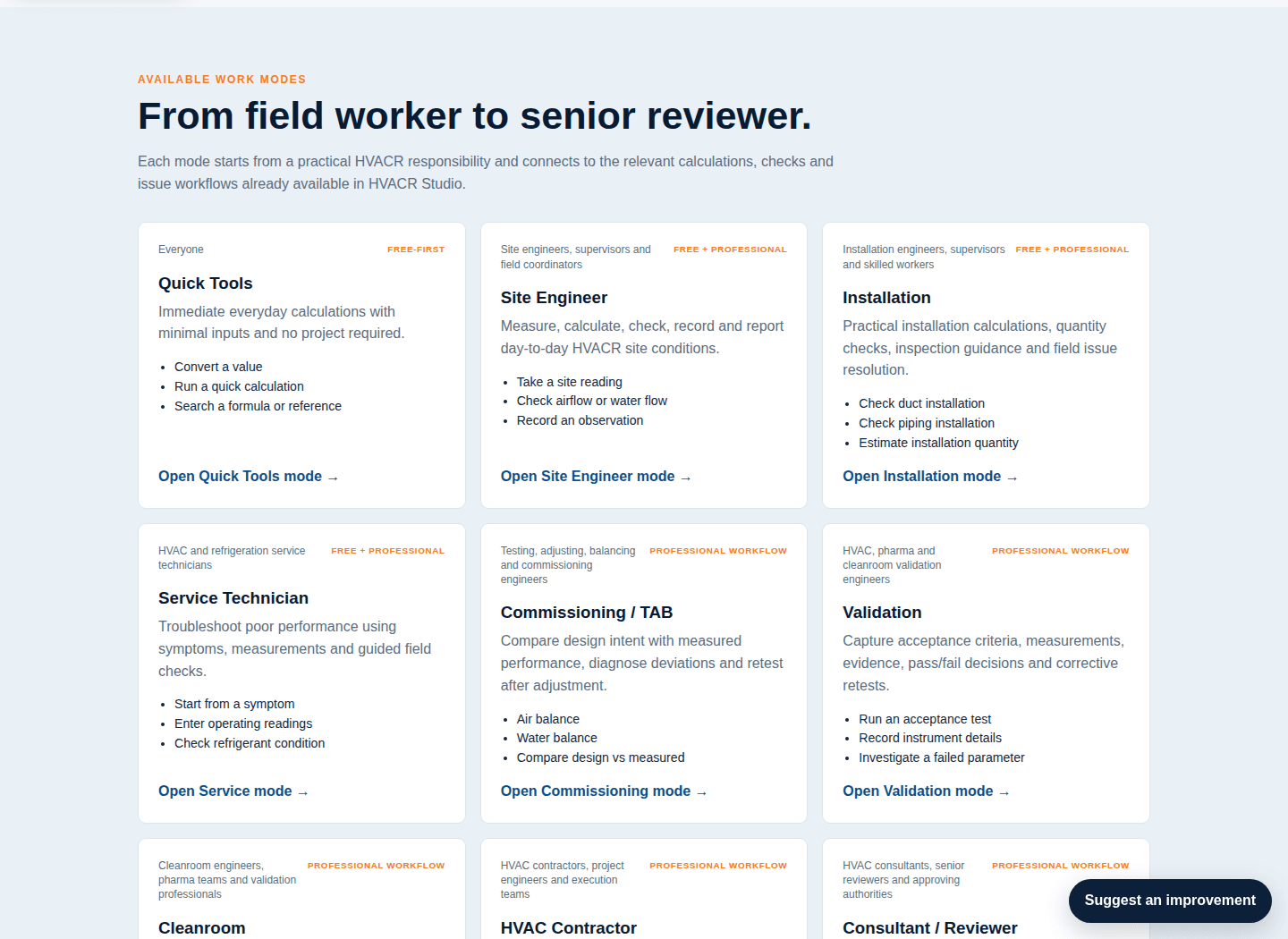
Each mode starts from a practical HVACR responsibility and connects to the relevant calculations, checks and issue workflows already available in HVACR Studio.
Immediate everyday calculations with minimal inputs and no project required.
Measure, calculate, check, record and report day-to-day HVACR site conditions.
Practical installation calculations, quantity checks, inspection guidance and field issue resolution.
Troubleshoot poor performance using symptoms, measurements and guided field checks.
Compare design intent with measured performance, diagnose deviations and retest after adjustment.
Capture acceptance criteria, measurements, evidence, pass/fail decisions and corrective retests.
Air-change, pressure, moisture and airflow checks tailored to controlled environments.
Execution-focused calculations, checking, coordination, measurement and documentation around the approved design.
Review submitted values, methods and performance without duplicating detailed building heat-load design.
Refrigerant reference, system checks and progressively deeper refrigeration-cycle analysis.
Cold-room field performance, pull-down, refrigeration and moisture checks without replacing detailed load-design software.
Flow, pipe, pressure, pump and valve checks using known design or measured duty.
Airflow, ventilation, duct, coil and AHU checks around the design and installed system.
Compare design and actual HVACR performance and identify efficiency degradation.
Fast customer-facing calculations, application checks and equipment data capture.
Plan preventive maintenance, keep equipment history, surface recurring issues and verify maintenance impact against the same project equipment register.
The same project and equipment context can carry measurements, evidence, corrective actions, retests and verification forward instead of leaving each activity as an isolated form.
Compare design intent with measured air or water performance, adjust where required and preserve the retest trail.
Capture acceptance criteria, instrument context, measurements, deviations and the evidence used for pass/fail decisions.
Connect preventive maintenance, equipment history, recurring issue signals and maintenance impact to the same asset record.
This map explains how HVACR Studio connects work records. It does not imply autonomous diagnosis, acceptance or engineering sign-off; judgement remains with the responsible professional.
HVACR Studio is intended for users ranging from installation teams and service technicians to commissioning engineers, consultants and validation professionals. The interface should reduce software terminology without hiding the engineering method.